
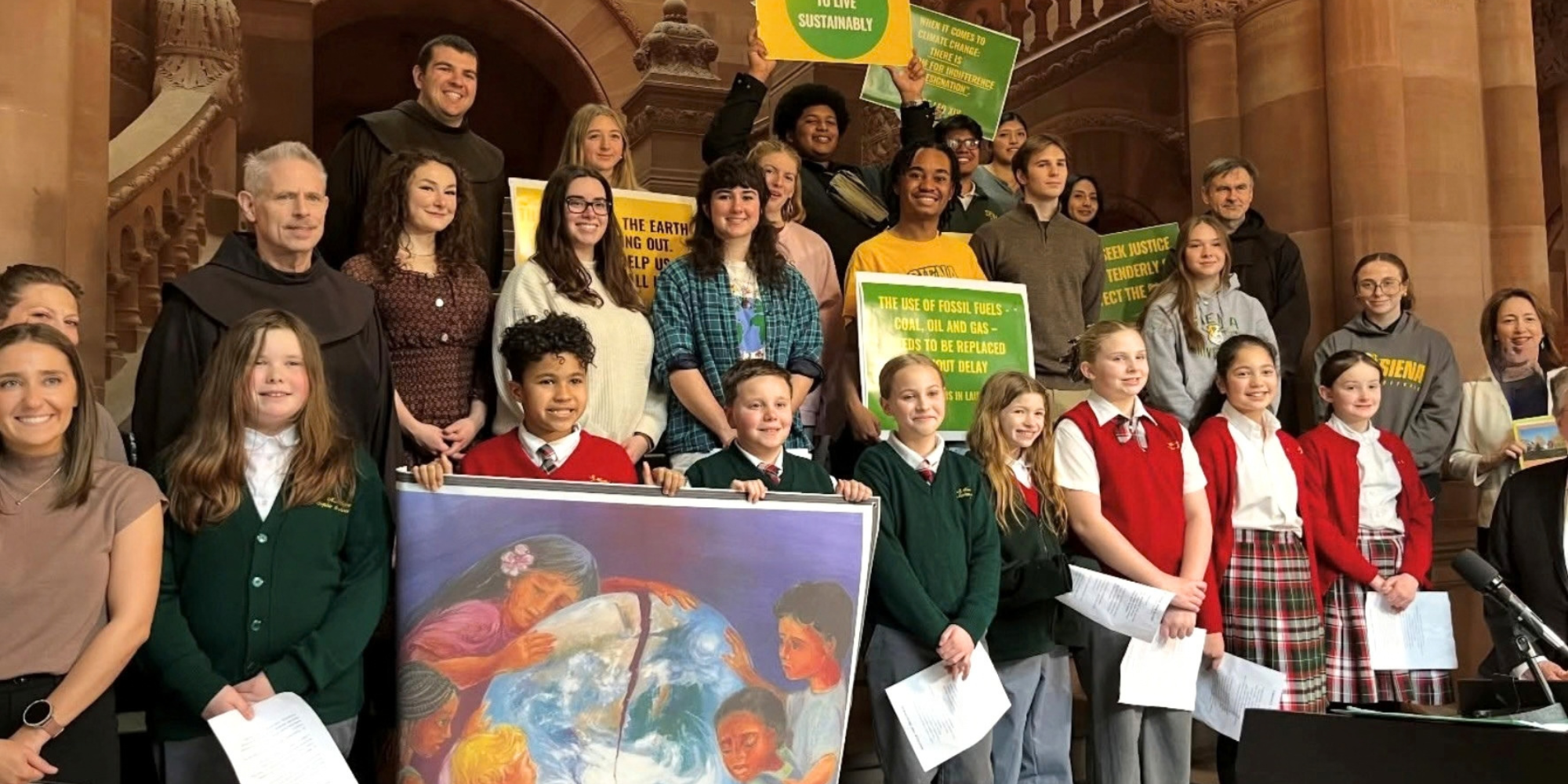
Friars and students sound the alarm on plastic pollution and champion a systemic solution
More than 800 years ago, St. Francis of Assisi composed The Canticle of the Creatures, inspired by a deep conviction that all life is connected and that humans are responsible for caring for creation.
Today, students and friars at Siena University are applying his vision to one of the most pressing environmental challenges of our time: plastic pollution.
At the Loudonville, New York, school, student leaders are educating lawmakers, the media and the community about the dangers of plastic pollution and highlighting solutions to improve humanity’s health. Their work is rooted in integral ecology, an understanding that concern for the environment is inseparable from concern for human dignity.
Earlier this year, the Laudato Si' Center for Integral Ecology at Siena University organized a Pilgrimage of Hope for Climate Justice to the New York State Capitol, where students held a news conference. Br. Jacek Orzechowski, OFM, the Center’s associate director, led participants in prayer. Some students, including Tallulah Powers, addressed media members, legislative leaders and representatives.
“Plastic pollution and the ‘culture of waste,’ as Pope Francis called it, are literally killing us. It amounts to a large-scale gamble with severe consequences,” said Tallulah, a senior philosophy major.
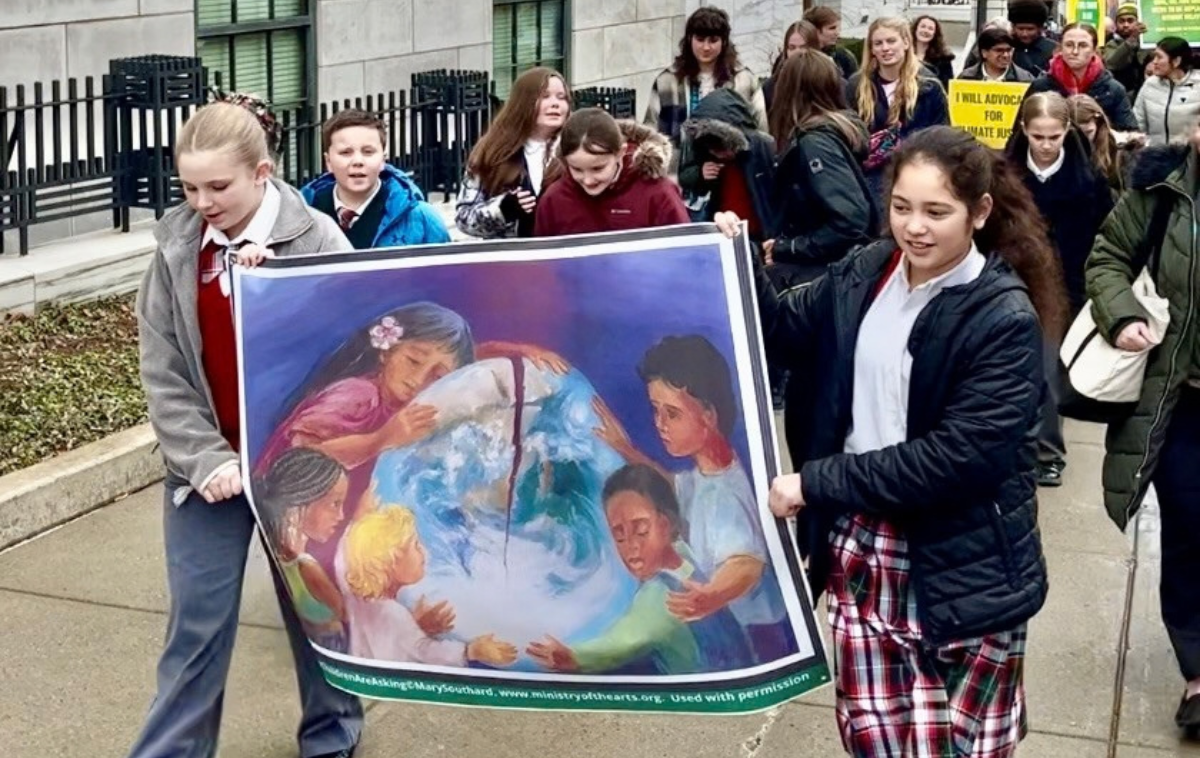
Siena University joined students from local Catholic and public schools on March 23, 2026, for the Pilgrimage of Hope for Climate Justice. The group marched from St. Mary’s Church in downtown Albany to the New York State Capitol, where they held a news conference and delivered copies of Laudato Si’ to state legislators. (Photo courtesy of Br. Jacek Orzechowski, OFM)
The ubiquitous nature of microplastics
For Franciscans, caring for creation begins with paying attention to the interconnectedness of life. The very nature of plastic pollution illustrates how deeply connected environmental and human health concerns have become.
“All this plastic is laced with 16,000 chemicals which add to the ubiquitous nature of microplastics. They are found in our brains, hearts and lungs, placenta, breast milk and now even in newborn babies,” said Tallulah.
Some friars, students and staff of Siena University also advocated for the passage of New York’s Packaging Reduction and Recycling Infrastructure Act, designed to hold companies accountable for plastic waste, requiring that they reduce packaging waste, pay for waste management and eliminate toxic chemicals. It would have required large companies to reduce non-reusable single-use packaging by 30% incrementally over 12 years. Unfortunately the advocates were outspent and outnumbered by business lobbyists, and the law failed to pass during the 2026 legislative session.
Despite the challenges, Tallulah emphasized the need to remain hopeful.
“There is hope in realizing that we are not powerless and there is something worthy to fight for,” said Tallulah. “As Pope Leo said recently, there is no room for indifference or resignation.”
In addition to the news conference, students distributed copies of “Laudato Si,’” Pope Francis’ landmark encyclical on caring for our common home, to lawmakers.
Turning oceans into landfills
The Laudato Si’ Center for Integral Ecology hosts speakers on campus to promote environmental care, social justice and sustainable practices inspired by Laudato Si’ and St. Francis’ vision.
For example, Rev. Kathryn Beilke, an expert on the dangers of plastic, spoke about the threats posed by plastic pollution to our oceans and food supply, as well as its impact on climate change.
“We are turning oceans into landfills,” said Rev. Beilke, who shared that 15 billion tons of plastic end up in our oceans every year – the equivalent of two garbage trucks being dumped into the ocean every minute. Ninety percent of plastic in the ocean winds up in our waterways through illegal dumping, negligence or by accident.
Plastic is a climate change issue
Plastic pollution is more than a waste problem – it is also closely tied to climate change.
“Over the course of its life cycle – extraction, production, use, transportation and disposal – plastics are responsible for greenhouse gas emissions equivalent to 116 coal fire plants and will exceed the emissions of the entire coal sector by 2030, thus greatly exacerbating the climate crisis that affects every living being on this planet,” said Rev. Beilke.
She also shared that less than 6% of plastics in the United States are recycled. Many plastics contain additives and layers that make recycling difficult or impossible.
Moving beyond plastics
On Sept. 10, Tallulah, Br. Jacek and Br. James Kernan, OFM, were featured in a national webinar about the negative impacts of plastics on the planet and on vulnerable communities.
“This is an example of our efforts to promote civic engagement and to educate legislators and the community on issues related to climate justice and plastic pollution,” said Br. Jacek during the webinar. Br. Jacek also serves as animator for the Province of Our Lady of Guadalupe's Office of Justice, Peace and Integrity of Creation.
“Moving Beyond Plastics in a Throwaway Culture" was organized by the Franciscan Action Network, Beyond Plastics, Franciscan Federation and others. It explored how Franciscan eco-spirituality can guide our response to the ecological crisis of our time.
Author and environmental expert Judith Enck challenged participants to take action. “Production of plastic is expected to triple in the next few decades unless we adopt new laws and new policies to change that.”
Her proposed solution was straightforward.
“We need to make less plastic. It's that simple and it's that challenging at the same time.”
How to get involved
Urge members of Congress to reject efforts to weaken a federal law that enables the Environmental Protection Agency to protect health and the environment from harmful chemicals.
Join Beyond Plastics a grassroots movement working to reduce plastic pollution in towns and cities.
Review the U.S. Environmental Protection Agency’s National Strategy to Prevent Plastic Pollution.
View "The Plastic Detox," a Netflix documentary that follows six couples with unexplained infertility as they reduce their exposure to plastics in the hopes it will help them conceive.