
Five ways to fast from conflict and crisis
Conflict is a part of life, but it doesn’t have to lead to a crisis. Conflict often starts as a difference in values, opinions or priorities, and then we either find a peaceful resolution or it escalates, leading to verbal attacks, insults, or even worse, violence.
Following the example of St. Francis, we can learn to manage conflict and bring peace to our day-to-day encounters.
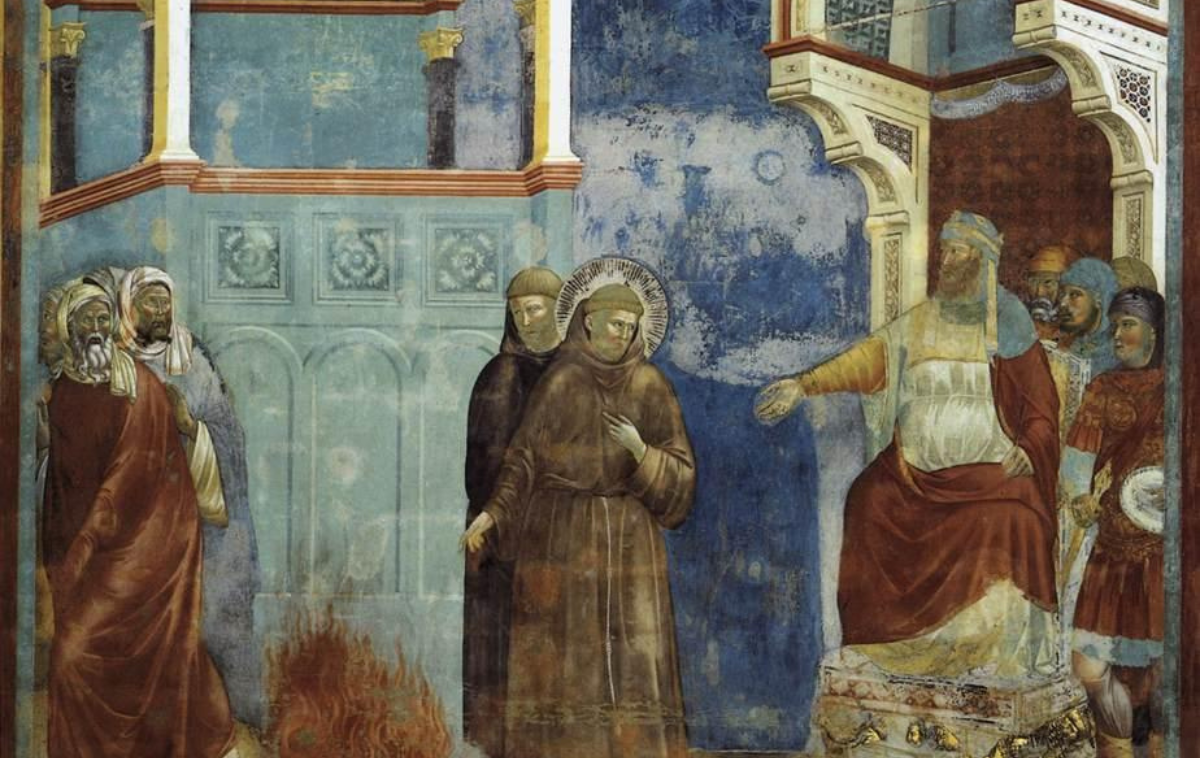
This painting captures the encounter between St. Francis of Assisi and Sultan al‑Malik al‑Kamil during the Crusades. St. Francis crossed enemy lines not with a sword, but with humility and hope — and found, in the sultan, a leader willing to welcome dialogue over violence.
Russ Testa, director of the Province of Our Lady of Guadalupe’s Office for Justice, Peace, and Integrity of Creation (JPIC), suggests five behaviors we should give up this Lent to avoid turning conflict into crisis. These tips can help us resolve conflicts and find common solutions. According to Russ, the path to greater peace can be found by avoiding these behaviors and attitudes when a situation becomes tense due to conflict.
Avoid immediate responses and reactions. “It’s important to take time to figure out how to respond,” said Russ. This involves stepping back for a time to thoughtfully understand what is causing friction and what is morally objectionable while recognizing the dignity of the person or people involved. “We need to understand and also acknowledge the full humanity and value of the other person, even if we totally disagree with them,” added Russ.
Avoid silence. “Through dialogue, we try to understand the other person. What are their motives, beliefs and perspectives?” said Russ. This involves asking questions, listening with an open heart and restating what you hear.
Avoid pride. “Even if you disagree with someone, you at least want to understand where they're coming from,” said Russ. This involves practicing humility. Accept that you may not have all the facts and be open to learning.
Avoid indifference. “We often want to avoid pain, seeing the tough stuff happening in the world. But we can’t do that. We need to bring that pain to God so we can act upon it,” said Russ. This involves praying with intention, showing empathy and taking peaceful action to make a difference.
Avoid letting the media normalize violence. “We should reflect on what we are watching so it doesn’t influence us to believe that the normal way to respond to conflict is violence. The path of non-violence is central to who we are,” said Russ. This involves recognizing that violent movies and videos typically attract more interest, but such entertainment is not consistent with the Gospel values of peacemaking.

This famous fresco shows St. Francis gently preaching to birds — a symbolic act of peace, compassion and reconciliation with creation.
Pope Leo XIV affirmed St. Francis as a role model for peacemaking while promoting peace with diplomats from around the world during a meeting last month. In his address, he emphasized the need for peace, justice and dialogue in a world increasingly marked by conflict and power struggles.
“This coming October will mark the eighth century of the death of St. Francis of Assisi, a man of peace and dialogue, universally recognized even by those who do not belong to the Catholic Church,” stated Pope Leo XIV. “His life shines brightly, for it was inspired by the courage to live in truth, and the knowledge that a peaceful world is built starting with humble hearts turned towards the heavenly city.”