
The Portiuncula: the little church where God finds us
Author: Br. Gilberto Cavazos-González, OFM
Date Published: July 31, 2026
As the feast of the Portiuncula approaches each Aug. 2, I find myself returning to the small chapel where St. Francis first gathered his brothers and where St. Clare stepped into Gospel life. This year, I want to bring that memory home to the cotidiano: the ordinary, unremarkable ground where we live our faith. What does a 13th-century friar’s walk into a sultan’s camp, or a papal gathering of religious leaders, have to do with your ordinary day? More than it first appears.
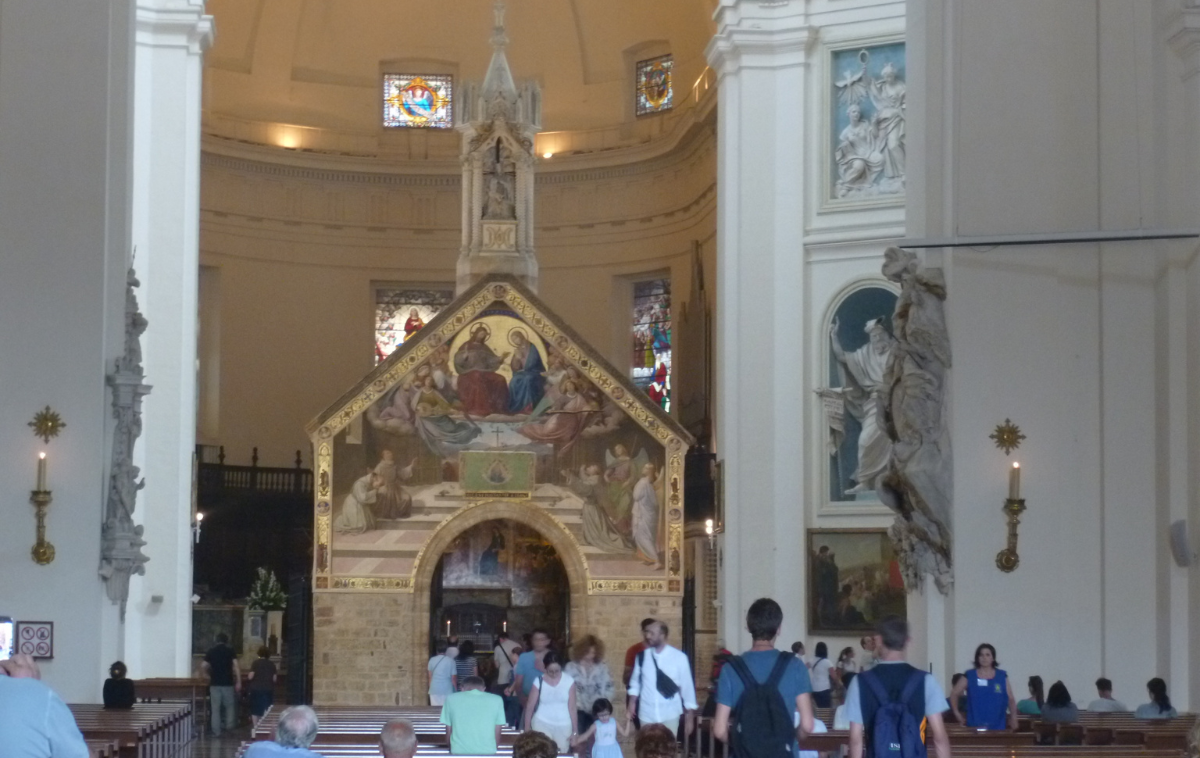
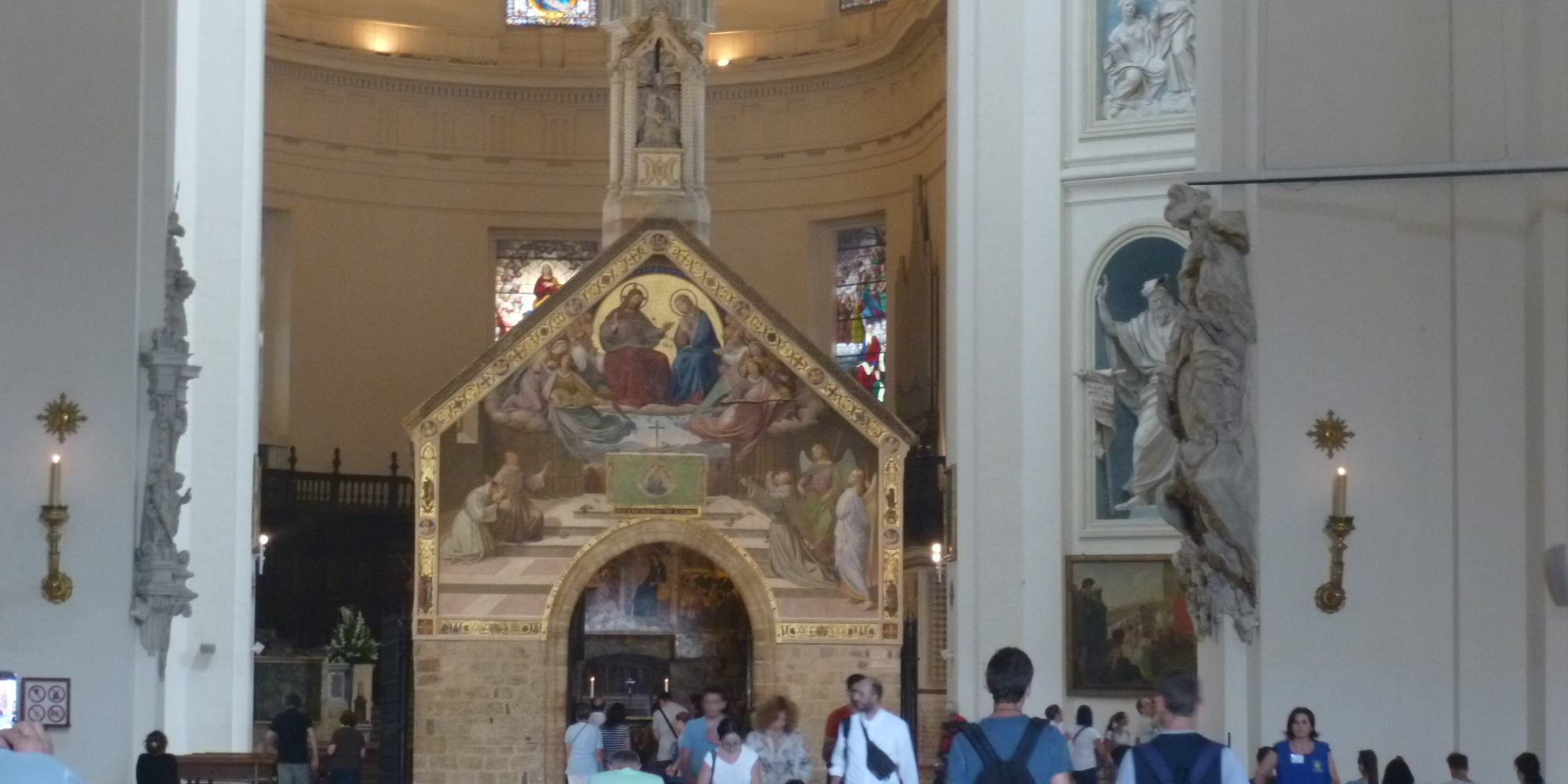
The Portiuncula - the little church where St. Francis first received the brothers and Clare in the way of minoritas - sits inside the Basilica of St. Mary of the Angels in Assisi. (By Diego Baglieri - Own work, CC BY-SA 4.0)
A grace small enough to fit a life
The Portiuncula is one of the small, ruined churches Francis rebuilt with his own hands, so modest that it now sits, almost shyly, inside the grander basilica built around it. And yet it is the place where he first received the brothers and Clare into the Gospel way of minoritas. It is the little portion of land from which he sent friars out two by two into the world.
The most consequential sending in Franciscan history did not happen from a place of power. It happened from a room barely large enough to hold twenty people in prayer.
This influences how we imagine our own cotidiano. We assume the significant things that God cares about – dramatic decisions, once-in-a-lifetime encounters – happen elsewhere. The Portiuncula insists otherwise. The little church is where the sending began. Our little portions – our rooms, kitchens, commutes, shift changes – are not the waiting rooms before spiritual life. They are where we encounter God and where God finds us.
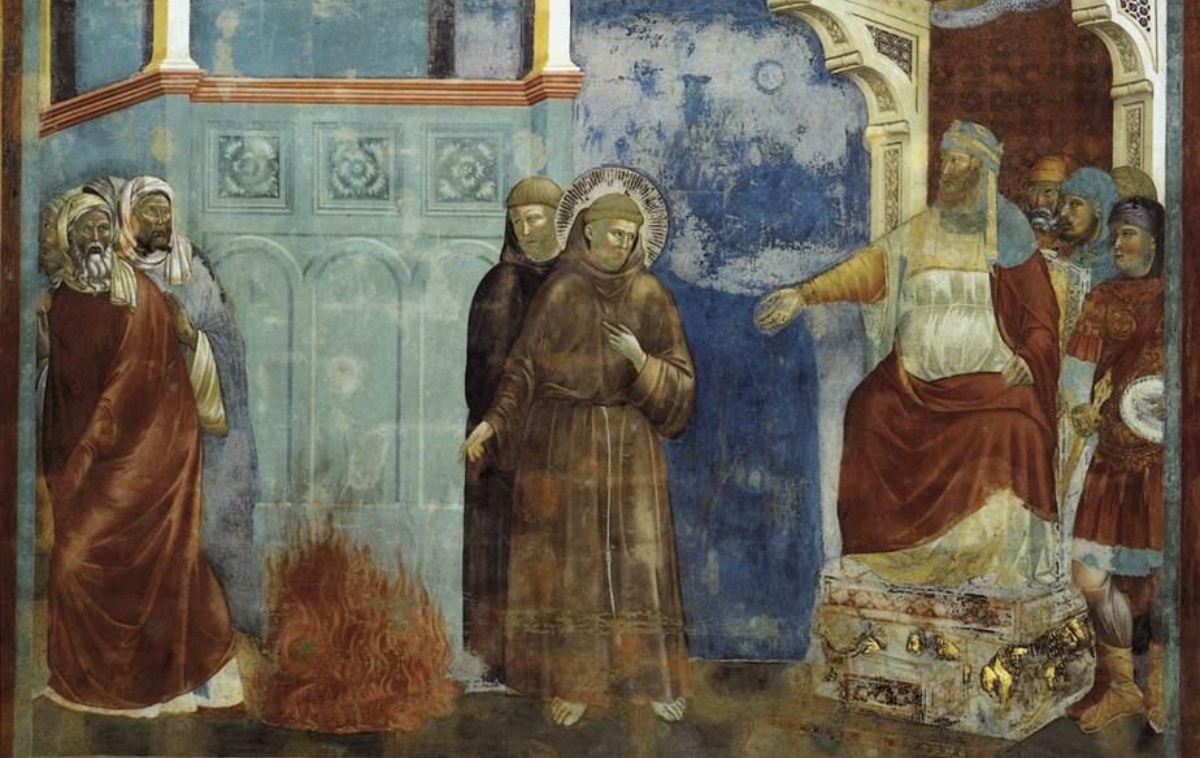
Neither St. Francis, left, nor the Sultan, were converted because of their encounter. Francis, however, made peace, from a position of vulnerability, not strength. (Formerly attributed to Giotto, Public domain, via Wikimedia Commons)
Peacemakers, not soldiers
There are two famous paintings that depict dramatic moments in Francis’ and Clare’s lives: Francis daring the Sultan’s holy men to an ordeal by fire, and Clare driving off attacking Saracens with the Eucharist raised like a mighty sword. Neither occurred that way.
Hoping for martyrdom, Francis crossed into the Sultan's camp not as a combatant but as a guest. He was welcomed, listened to and sent home alive, having neither converted the Sultan nor been martyred. The only fire was that of the Holy Spirit moving both men to listen to each other as brothers. Francis left the encounter alive and changed.
Clare was too frail to have physically driven anyone off. Witnesses at her canonization instead describe her praying before the Blessed Sacrament for her sisters’ safety and, I would like to believe, for the safety of the very people threatening them.
Neither fought. Both made peace from a position of vulnerability, not strength.
Our cotidiano is full of Saracens: neighbors whose politics alarm us, relatives we have stopped talking to, friends who ghosts us, coworkers whose faith – or lack of it – we quietly judge. The temptation is always toward the dramatically painted version of the story: the ordeal by fire, the vindication. The Spirit of Assisi asks something less satisfying and more difficult: showing up in the room with the person we fear and praying for and with them rather than against them.
Living quietly among the rest
After his return from Egypt, Francis instructed brothers living among Muslims to live simply and quietly as minores, admitting to being Christian without argument or debate; and let any preaching arise from the Spirit.
The friars who were killed in Morocco a year later did the opposite. They argued, they insulted, and they died for it — a testimony less to holiness than to how quickly quiet witness curdles into contest and one‑upmanship.
Our divided age still rewards what Francis warned against: winning the exchange rather than living the witness. The question is not what you would say to the people who trouble you, but whether you are willing to live faithfully among them first – and let speech guided by the Holy Spirit come later, if it comes at all.
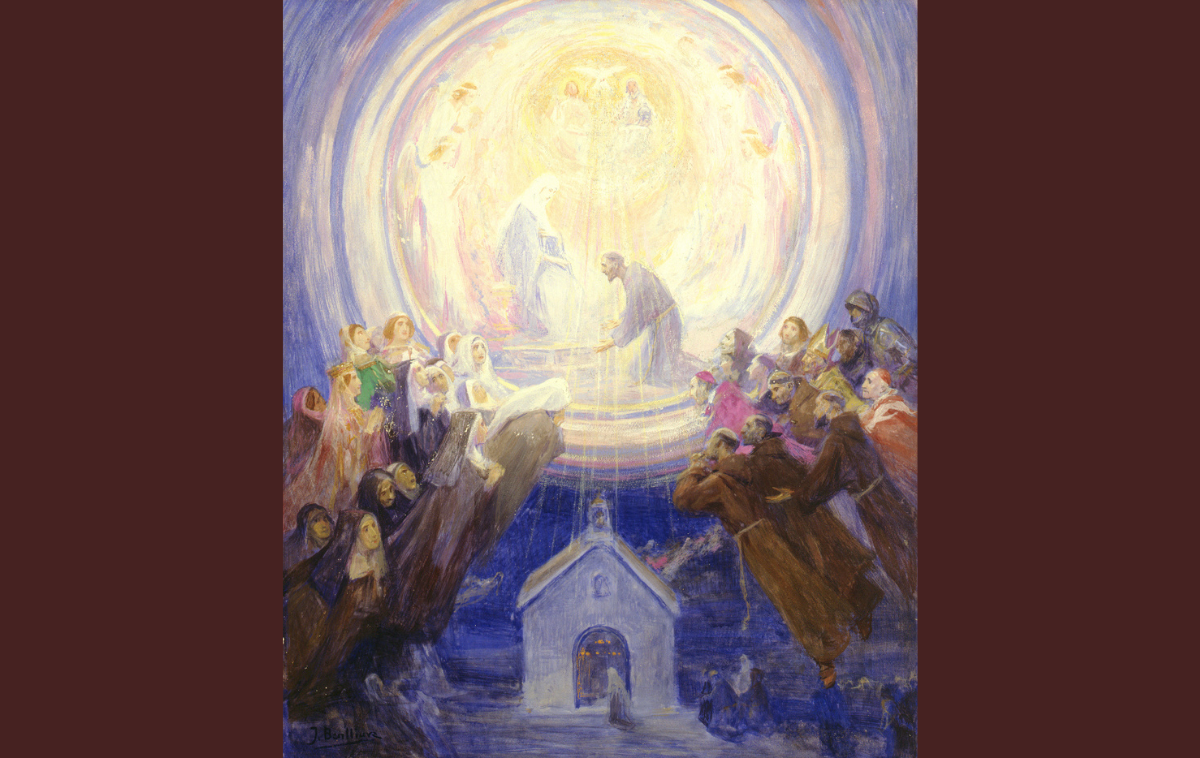
The Pardon of Assisi is a plenary indulgence that can be received through the Sacraments of Reconciliation and the Eucharist and visiting a parish or Franciscan church, reciting the Creed, the Lord’s prayer and praying for the Pope and his intentions. (José Benlliure y Gil, Public domain, via Wikimedia Commons)
The pardon that needed no battlefield
Plenary indulgences in Francis’s day were earned by fighting in the Crusades or making huge donations to the Church. Francis asked Christ for something else: that anyone who entered this small chapel, confessed, and prayed for pardon would receive the same remission – no battlefield required, no donation needed.
Miraculously, he got Rome to ratify it. He made the economy of the Crusades’ grace obtainable by walking into a room the size of a bedroom and being honest before God.
That is the socio‑spiritual heart of the Pardon of Assisi: grace was never only for to the heroic, violent or wealthy. It was always available in the small, repeatable, unglamorous act. Confession. Prayer. Eucharist. Presence. Enter the little chapel wherever you happen to find it – your life, your cotidiano.
¿Y qué? Where this leaves us
St. John Paul II, gathering religious leaders in Assisi in 1986, said that peace is built through a thousand small acts of daily living, and in the ordinary way we treat those around us; we are choosing for or against it.
That is the Spirit of Assisi translated into our cotidiano. Not a summit nor crusade, holy or otherwise. A thousand small choices, repeated, in spaces too modest to be painted.
As the feast of the Portiuncula approaches, I’m not asking you to travel to Assisi. I am asking where your own little chapel already is: the car before you go inside, the five minutes before your shift starts, the meal where a hard conversation awaits.
Go in. Confess what needs confessing. Confess you are a sinner. Confess your faith in the Triune God. Pray for Pope Leo’s wellbeing. Pray for the person you would rather not. Give Eucharistic thanks. Let pardon and wellbeing (pax et bonum) be as available to you today as they were to a 13th-century penitent walking into a rebuilt ruin outside Assisi.
¿Y qué? Now it is your cotidiano, and your turn to live the Spirit of Assisi.
Editor’s note: This post first appeared on the blog Gilberto Cavazos-González, OFM and has been republished here with permission.