
How the Gospel comes alive in the Rio Grande Valley
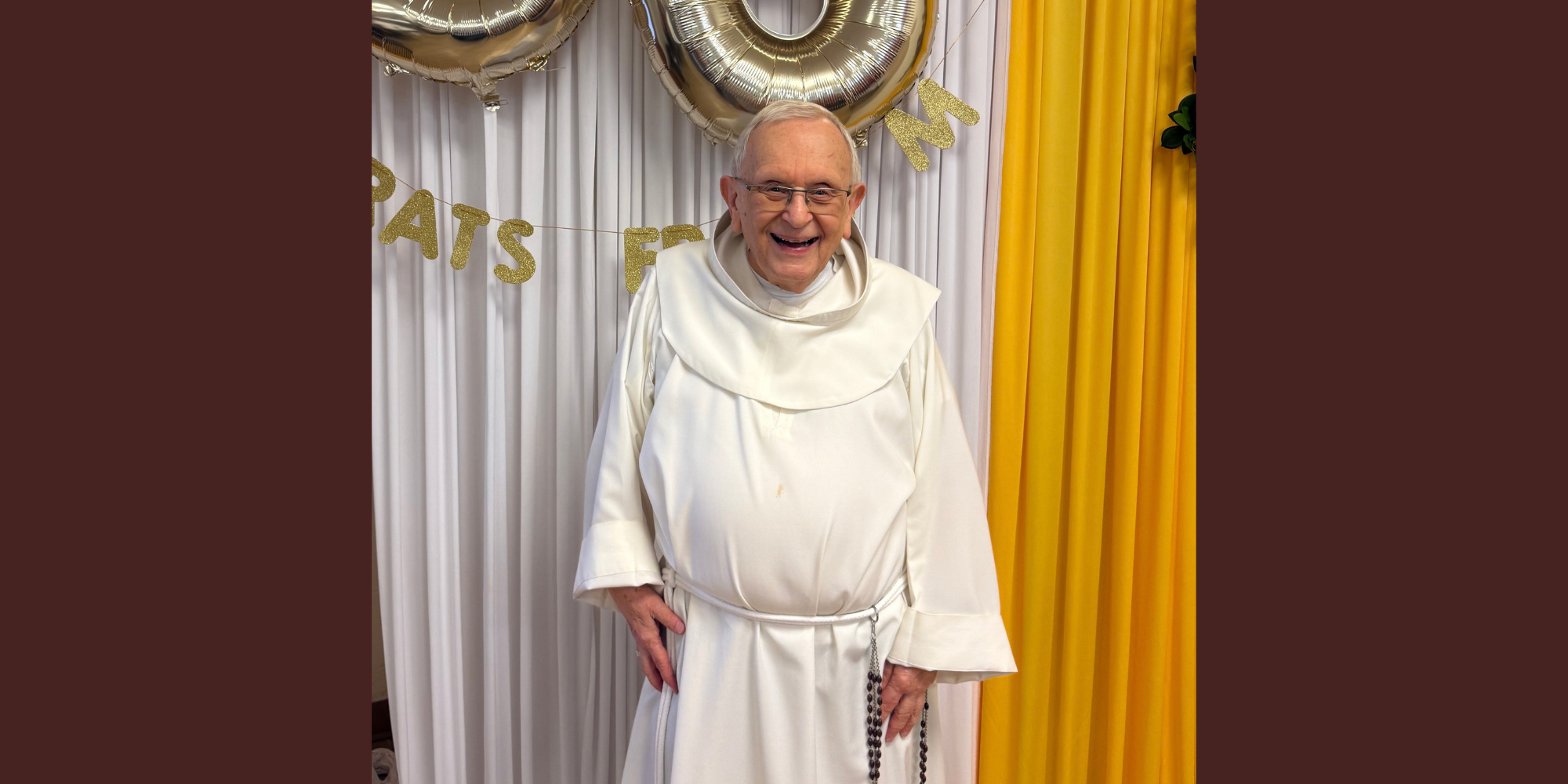
At the southern edge of Texas is a region Br. Thomas Luczak, OFM, calls “not really Mexico, and not really the United States.” It’s the Rio Grande Valley, a shared space where cultures meet; language flows freely, and generosity often springs from those who have the least.
Br. Thomas believes living and ministering in the Valley has transformed him just as much as it has called him to serve. Through encounters with migrants and parishioners at Holy Family Catholic Church in Edinburg, Texas, and Sacred Heart Catholic Church in McAllen, Texas, who share freely what they have, he has come to see a profound expression of Franciscan life – one rooted not in giving from abundance, but in recognizing the face of God in others and responding with a love that excludes no one.
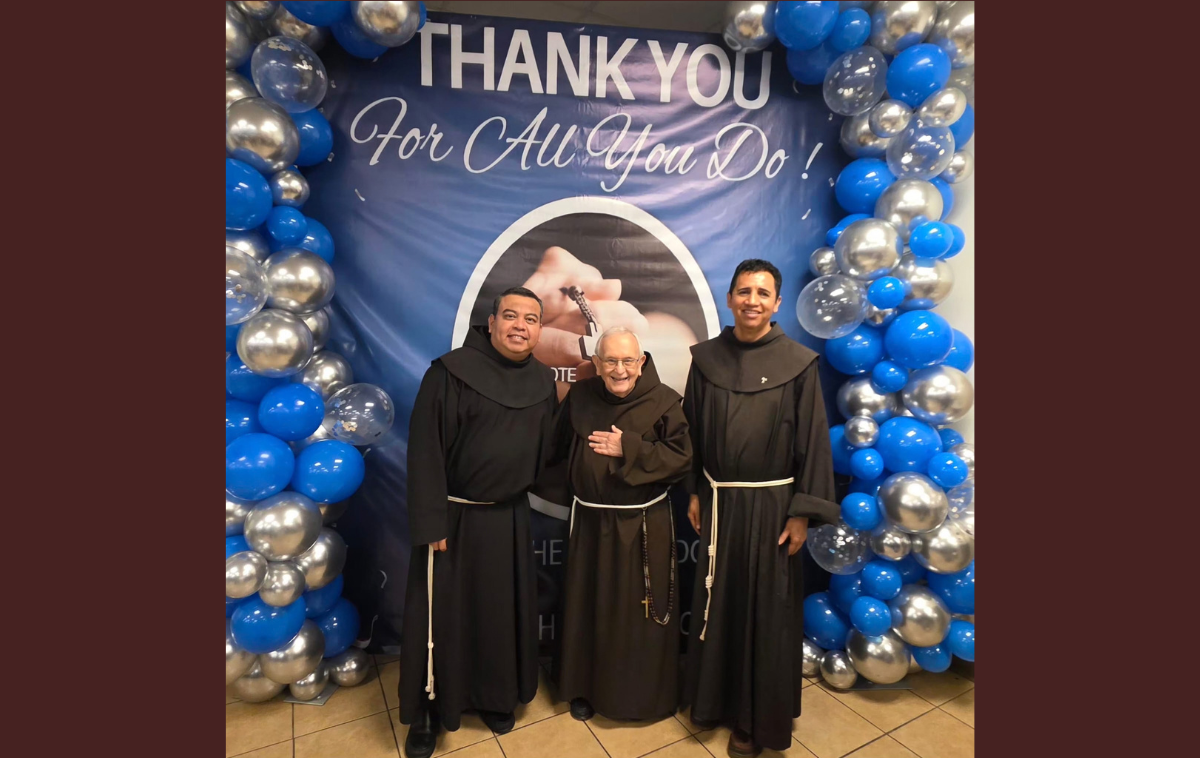
The Holy Family Catholic Parish in Edinburg, Texas, recently celebrated Br. Thomas Luczak’s 56 years as a priest. He’s pictured here with Brothers Edgardo Diaz, OFM (left) and Erasmo Romero, OFM, who also serve in Edinburg. (Photo courtesy of Br. Thomas)
Encounters that reveal the Gospel
One morning at Sacred Heart, Br. Thomas stepped outside on his way to Mass and found two men asleep beneath a banana tree on parish grounds. They had arrived overnight, he said, with little more than what they could carry. One man lost his clothes while crossing the river and had only a T-shirt and underpants.
They asked for food, but Mass was about to begin. Br. Thomas invited them first to come and give thanks for their safety. Within half an hour, parishioners gathered clothes, food and whatever else they could spare – offering, without hesitation.
Such scenes are not unusual.
In the Valley, Br. Thomas said, people often respond to need without missing a beat. Over time, he came to recognize in that steady generosity a deeper way of living the Gospel – one expressed not in grand gestures, but in ordinary acts of care.
That witness, he said, also began to change him.
He acknowledged that, at first, he sometimes felt the same quiet frustration many people do when approached by those asking for help on the street. But gradually, the example of those around him – and the lives of the people he encountered – reshaped the way he responded.
“I’m sure none of these people… when they were little, said, ‘When I grow up, I want to sell water on the street,’” he said.
Instead of stopping at irritation or suspicion, he found himself looking more closely at the person before him and responding first to their immediate need. In that shift, he began to see more clearly what St. Francis himself discovered in his encounter with the leper: that love begins not in judgment, but in encounter.
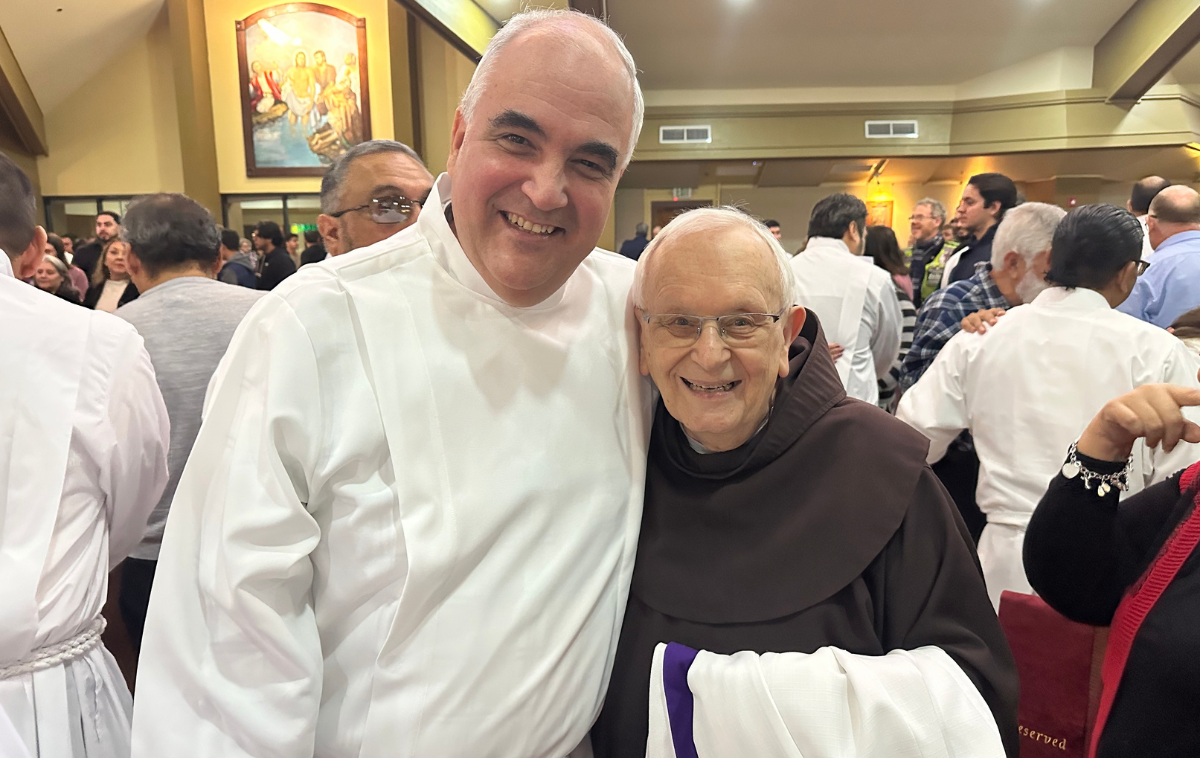
Br. Thomas, with Fernando Ancer. Br. Thomas has served for several years as a spiritual director of men who are studying to become a deacon for Diocese of Brownsville, Texas. This was the ceremony when he was recognized as a candidate for diaconate. (Photo courtesy of Br. Thomas)
Family as a model of fraternity
That same spirit, Br. Thomas said, extends beyond moments of immediate need and into the very cadence of life in the Valley.
Families remain deeply connected, often caring for elderly relatives at home for as long as possible. Responsibility is shared, and support stretches beyond immediate relatives. Sponsors for the sacraments are not merely symbolic; they often become part of the family itself, accompanying children and parents alike through the ordinary rhythms of faith and daily life.
Witnessing those relationships has also led him to reflect on his own vocation.
“Is our bond as friars as strong as their bond as family?” he said.
For Br. Thomas, the question is not a critique so much as an invitation — one that points to a deeper understanding of fraternity, rooted not only in shared mission, but in lived relationships of care, presence and commitment.
That witness has also shaped how he understands God’s presence in the world.
“God does not have one face,” he said. “God has many faces.”
Living in the Valley, he explained, has taught him to recognize those faces in the people he meets, the culture that has welcomed him and the communities that continue to shape him. It has also meant learning to live within a world not entirely his own.
“You have to think Valley,” he said. “You can’t think just Mexican, and you can’t think just American.”
For Br. Thomas, that experience has become an invitation to see more deeply and to remain open to the many ways God’s presence is revealed through others.
He has come to understand that the heart of his ministry is found in these everyday encounters — not in what he gives, but in what he shares, and in how willing people are to recognize one another as part of the same circle, where no one stands outside.
“I receive more than I give,” he said. “Sometimes, I think the people are more of a blessing to me than I am to them.”