.png?sfvrsn=f81330d3_1)
Embrace the marginalized like Francis
In a world that cries out for peace and justice, Pope Leo XIV has announced a Jubilee Year of St. Francis – an urgent invitation to put our faith into action following the example of St. Francis of Assisi. As the Jubilee Year continues, the Franciscan Friars of the Province of Our Lady of Guadalupe will be sharing a monthly reflection to look honestly at our lives and ask what it would mean to follow the Gospel more closely in the spirit of St. Francis. Read other reflections in the Live Like Francis series.
In Chapter IX of the Earlier Rule of the Friars Minor (1209/10) St. Francis writes:
Let all the brothers strive to follow the humility and poverty of our Lord Jesus Christ and let them remember that we should have nothing else in the whole world except, as the Apostle says: having food and clothing, we are content with these.
They must rejoice when living among those considered of little value and looked down upon, among the poor and powerless, the sick and lepers, and beggars by the wayside.
When it is necessary, they may go for alms. Let them not be ashamed and remember, moreover, that our Lord Jesus Christ, the Son of the all-powerful living God, set His face like flint and was not ashamed.
Under the section “Begging Alms,” St. Francis presents a core element of Franciscan life: a connection with and an embrace of those on the margins. This invitation would have been challenging then – perhaps the reason it was left out of the Later Rule of 1223! – and it remains so today.
No one is unworthy of love
Is it truly possible to embrace the marginalized, or do we content ourselves with leaving that call to those we deem “more inclined” to do so? Our society and culture often label the marginalized as the poor, the disaffected, those judged as lost or unworthy of care. We entrust these “lepers” to structures and agencies to address the “problem.”
But Francis’ way of living the Gospel challenges us to embrace not only those who are pushed to the margins, but also to embrace those who marginalized them: people whose hearts have grown distant – shaped by fear, indifference or exclusion.
In this sense, marginalization takes more than one form. Some people are pushed to the edges of human community, while others, knowingly or unknowingly, distance themselves from the love of God that binds us together.
St. Francis does not ask us to choose one. He calls us beyond such distinctions.
St. Francis understood the futility of sharp divisions between condemnation and praise. By embracing all people – rich and poor alike – he ensured his movement could not be reduced to a “special interest,” stripped of its power and Gospel depth.
Embracing the marginalized – whether they are marginalized from society or from God – must be marked by a sincere commitment to live the greatest commandment: to love one another. Such love is not one-sided but mutual. It restores dignity, revealing each person as worthy, valued, and beloved.
At the same time, love confronts marginalization’s toxic roots – fear, ignorance and indifference – and transforms them into openness, understanding and mutual acceptance. In this way, love becomes the bridge that brings together what has been divided and leads others, and us, back into deeper communion.
Reflect
In what way does love function as a bridge-builder in your life? What has been life-giving for you and for others when you reflect on this dynamic?
Who are those who have been marginalized, whether intentionally or unintentionally, in your life or in your experience? Why has this occurred, and what or who has contributed to the marginalizing?
What is the challenge you and others face when confronted with responding to those who marginalize? What ideas might help to heal and transform the situation and the lives of those involved?
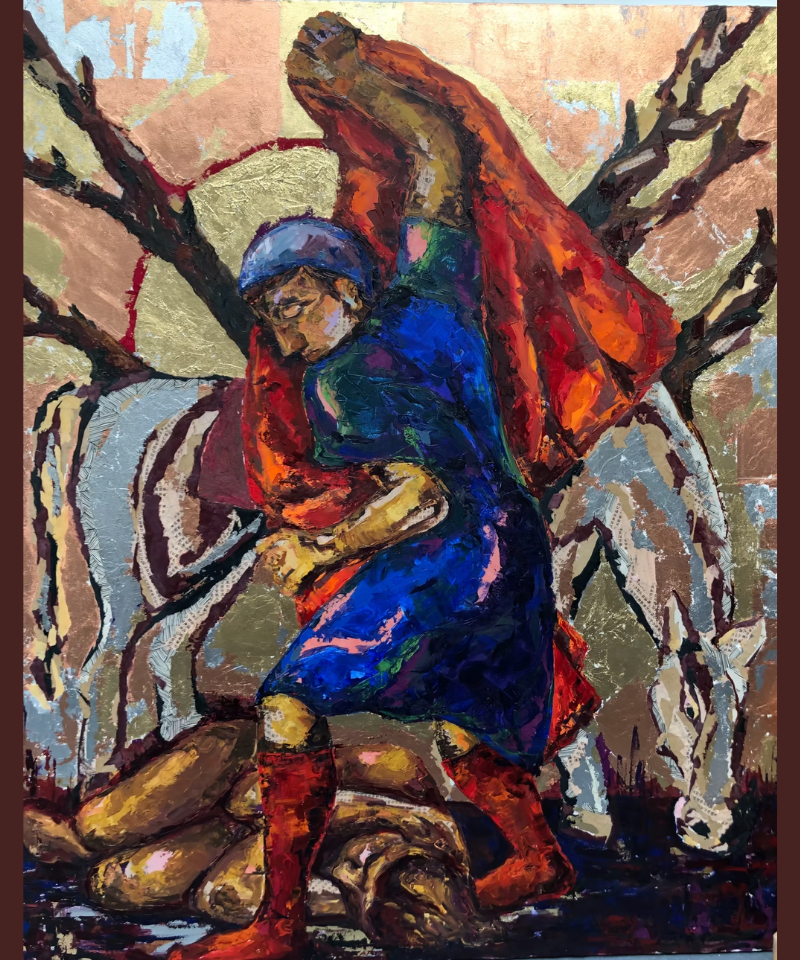
Image: St. Francis and the Leper by Br. Michael Reyes, OFM