
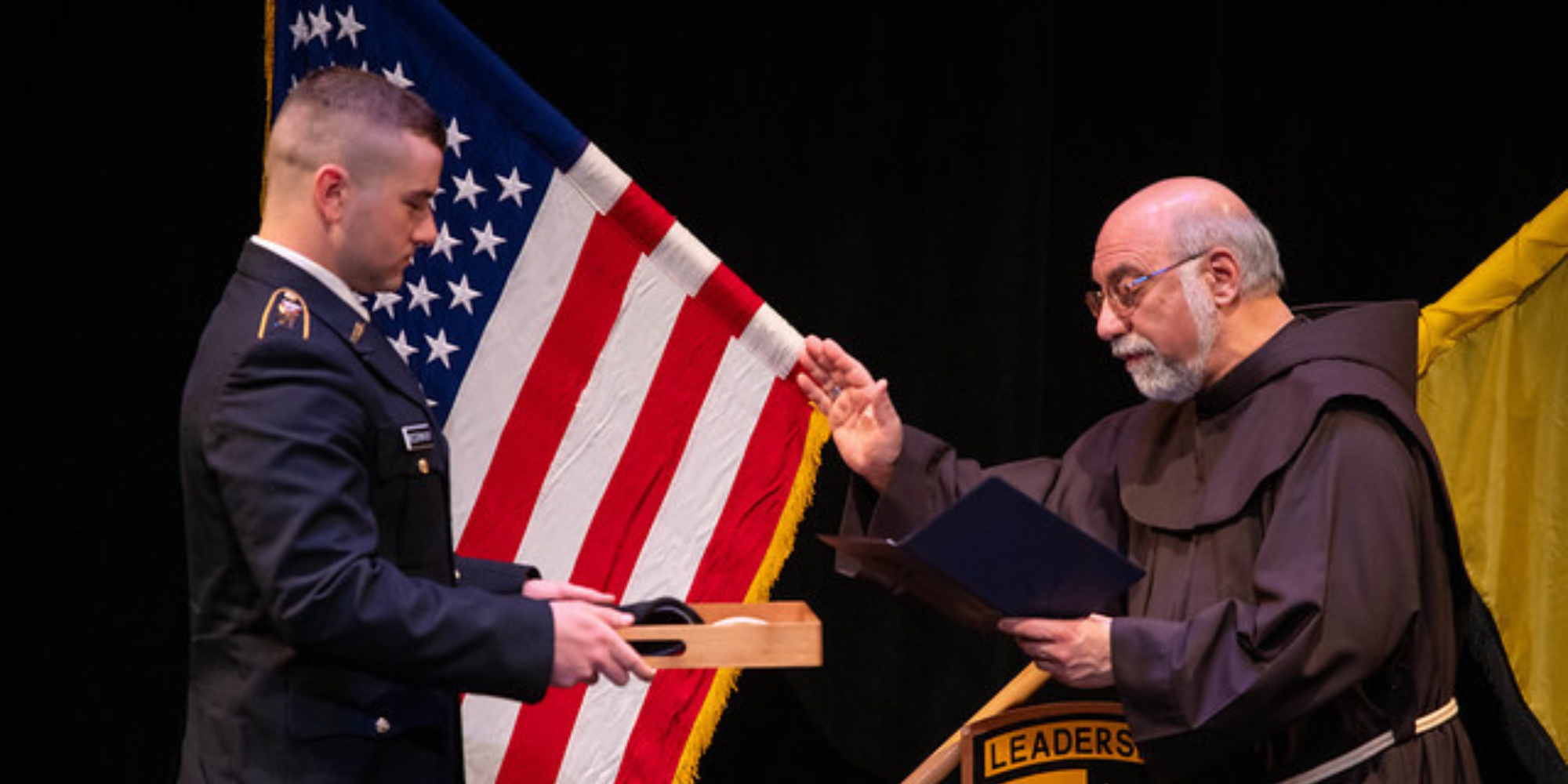
Fr. James Vacco, OFM, inducted into ROTC and Military Hall of Fame
On Saturday, March 21, St. Bonaventure University posthumously inducted Fr. James Vacco, OFM, into its ROTC Hall of Fame, honoring a friar whose ministry shaped generations of Army officers through faith, conscience and moral leadership.
The ceremony was held at the Doyle Chapel and included a plaque presentation for the Reilly Center (the school’s multi-purpose arena), his family and St. Bonaventure Church in Allegany, New York, where Fr. James had served as pastor from 2011 to 2022.
While he was pastor, Fr. James also served as an adjunct professor and a chaplain for the Seneca Battalion, the school’s ROTC program that trains college students to become commissioned officers in the U.S. Army, National Guard, or Army Reserve. The program is recognized as one of the top programs of its size in the country.
During Fr. James’s tenure, more than 130 cadets were commissioned as second lieutenants, many of whom turned to him for guidance as they trained in military service.
His role extended well beyond formal ceremonies. Lt. Col. Sean D. Coulter, USA (Ret.), former professor of military science at St. Bonaventure, remembered that Fr. James was the first member of the school's community to welcome him upon arriving in 2016.
“He immediately made my family and me feel as though we had come home,” Lt. Col. Sean wrote. After almost 20 years of active-duty service and frequent relocations, he said it took “something special” to ease the transition to Western New York. “Fr. Jim was that special presence for us and for so many others.”
That spirit of hospitality reflected Fr. James's Franciscan approach to ministry; one rooted in presence rather than instruction. Known for his joyful demeanor, love of creation and ease in conversation, he offered cadets a steady moral compass during times of transition and uncertainty.
Fr. James’s advocacy for ROTC was grounded in principles he articulated after the 9/11 attacks when he wrote publicly about the compatibility of ROTC with the work of a Catholic‑Franciscan university.
“True leaders are individuals who not only have vision but values,” he wrote.
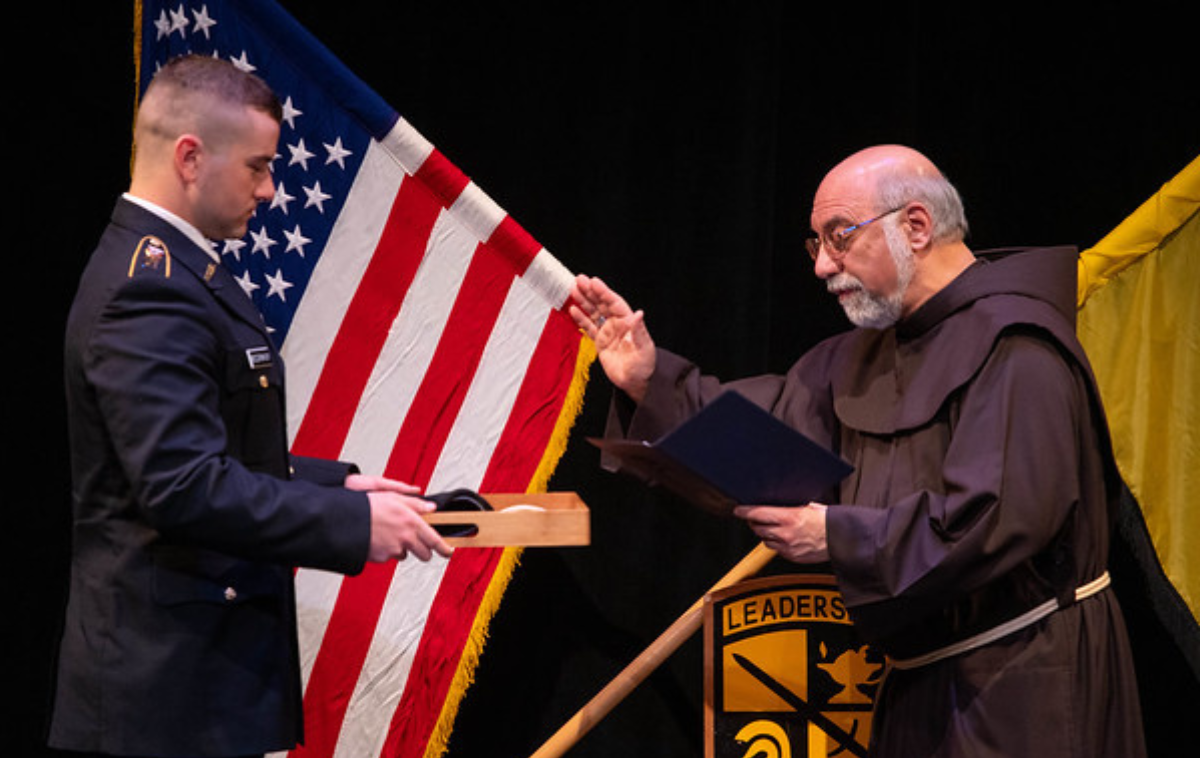
Fr. James Vacco, OFM, offered spiritual support and guidance to service members. (Photo courtesy of St. Bonaventure University)
'Leaders must not allow vengeance to guide their answers’
Recognizing that ROTC prepares leaders for the harsh reality of combat, something no one committed to peace wants, Fr. James argued that leadership must be shaped for an imperfect world. When aggression and tyranny arise, he wrote, military leaders must not allow vengeance to guide their actions.
“Good leadership realizes that reaction to aggression and hostility is more than just conquest,” he wrote, “but a restoration of a system of values within a humane society.”
Fr. James believed ROTC’s purpose was not to glorify force, but to form leaders adept at moral restraint, discernment and justice ordered toward peace. He rooted that vision in the Catholic moral tradition, often citing Gaudium et Spes, the Second Vatican Council’s pastoral constitution on the Church in modern times. The document calls those in military service to consider themselves as “agents of security and freedom on behalf of their people,” genuinely encouraging the establishment of peace.
Those beliefs guided Fr. James’s ministry for more than two decades.
Fr. James passed away unexpectedly on Dec. 19, 2025, at Assumption of the Blessed Virgin Mary Friary in Pulaski, Wisconsin. He was 70 and had begun a new pastoral assignment there in 2024.
He is survived by his brother, Vincent Vacco; his sister‑in‑law, Louise Vacco; their children; and his brother friars of the Province of Our Lady of Guadalupe.
In honoring Fr. James, the ROTC and Military Hall of Fame acknowledge not only his service as chaplain, but as a friar who showed that even amid conflict, leadership rooted in morality and a commitment to peace remains possible and necessary.