
Friars at the forefront of search for climate solutions
More than 500 students, environmental activists, faith leaders and outside guests attended “Earth’s Cry, Humanity’s Call,” Siena University’s 2nd annual symposium on integral ecology, held Feb. 5 on its campus in Loudonville, New York.
This year’s theme, “Reimagining Economy: For People and Planet," explored how economic systems can better serve human dignity and the environment, grounded in Franciscan values and care for creation.
Br. Michael Perry, OFM, director of Siena's Laudato Si’ Center for Integral Ecology, which sponsored the event with the School of Business and the Spirit of '68 Committee, called the symposium "a search for positive, necessary solutions to the existential crisis of global warming and climate change." The symposium was planned by Br. Michael, Br. Jacek Orzechowski, OFM, Br. Jimmy Kernan. OFM, and the Laudato Sí Center’s student team.
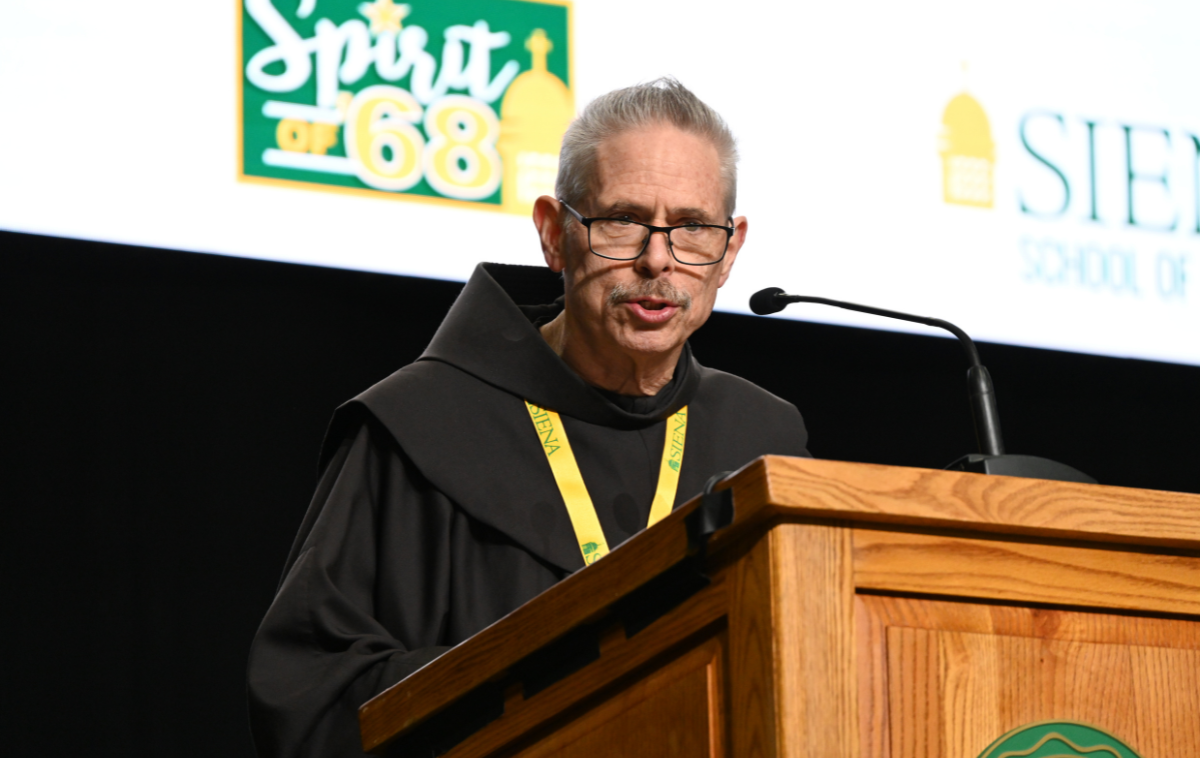
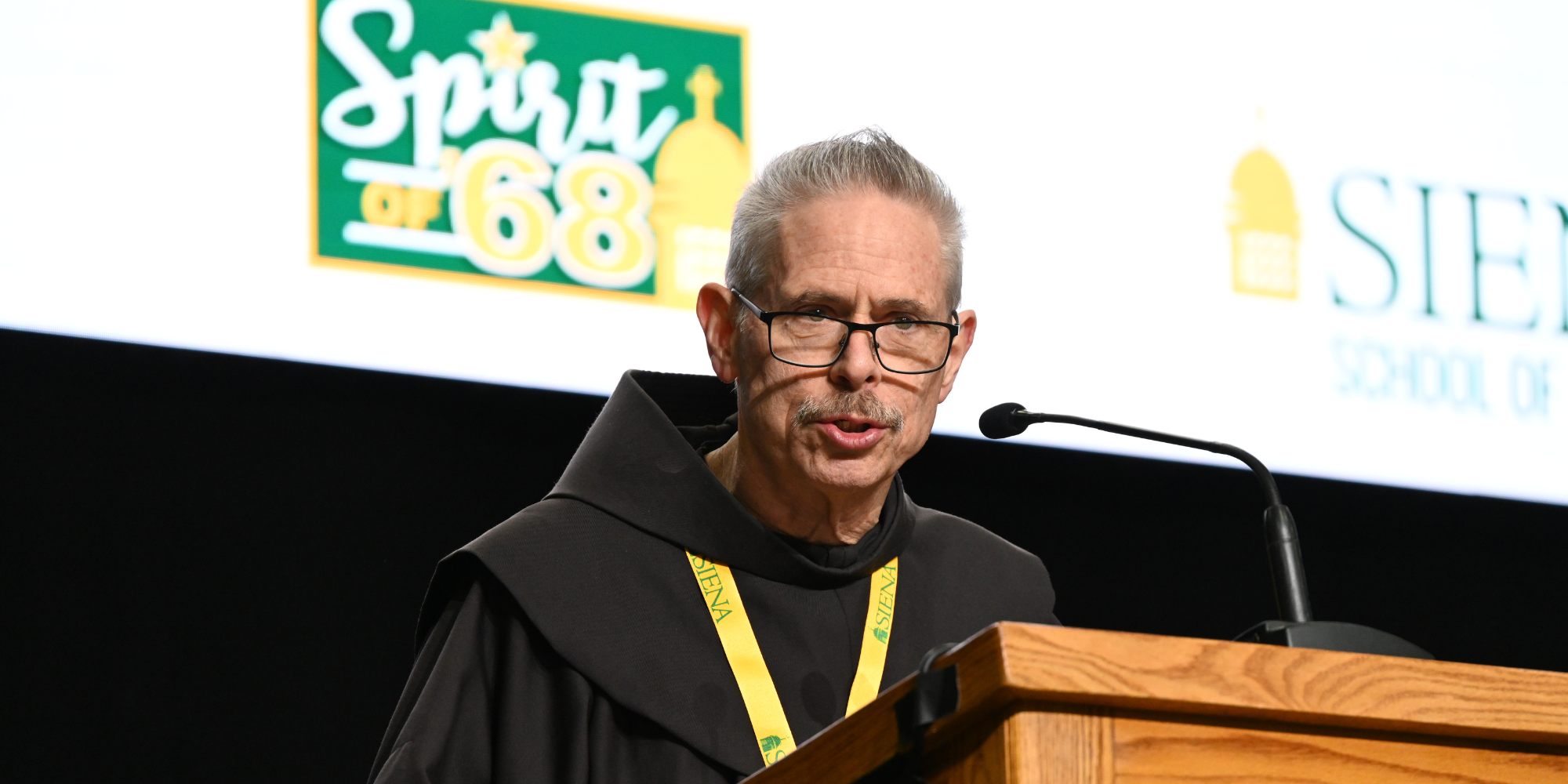
Br. Michael Perry, OFM, director of the Laudato Si’ Center for Integral Ecology, addresses attendees during the Feb. 5 symposium. (Photo courtesy of Siena University)
In his opening remarks, Siena President Chuck Seifert, Ph.D., said that Siena sees integral ecology not as an abstract concept but as "a way to see the world in a way that recognizes the deep interconnectedness among people, the planet, and purpose. St. Francis viewed the Earth not as a resource to be exploited but as a sacred living gift that sustains and nurtures all life."
Watch On Demand: Livestream links are available for the symposium's morning session and keynote address.
A Franciscan approach to economics
The symposium began with an address by Bishop John Stowe, OFM Conv., of Lexington, Kentucky, who examined how St. Francis’s poem the Canticle of the Creatures inspired the late Pope Francis to write Laudato Si’. He also discussed how, in modern times, we fail to live in the harmony that St. Francis depicted through the Canticle.
Province of Our Lady of Guadalupe friar Br. Ryan Thornton, OFM, Ph.D, STL, author of “Franciscan Poverty and Franciscan Economic Thought (1209–1348),” responded to Bishop Stowe’s remarks by sharing how the rich depth of the Franciscan tradition can shape our understanding of economics.
While our current economic model seeks to maximize growth, efficiency and profit, Franciscans view economic exchange as a natural sharing of gifts aimed at maximizing the benefits for each person involved in the exchange. There is no winner or loser – rather, both leave the exchange satisfied.
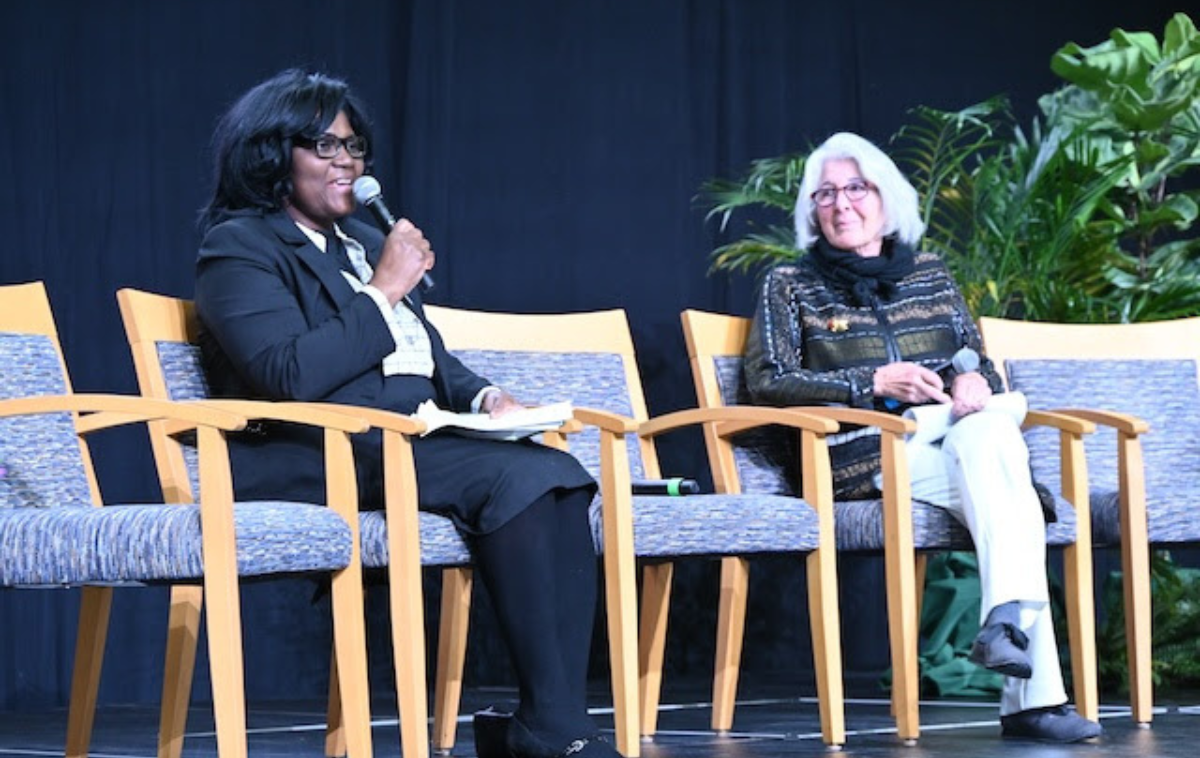
Amy Domini, of Domini Impact Investments Fund, right, looks on as Andrea Smith-Hunter, Ph.D., professor of management at Siena, introduces the panel discussion on the importance of a fair, just and equitable economy. (Photo courtesy of Siena University)
Economic development and interconnected communities
Aaron Pacitti, Ph.D., professor of economics at Siena, and Kirsten S. Moy of the Aspen Institute, led a dialogue on “Societal Impact and Integral Community Development.” During the conversation, Kirsten proposed that economic development works best when it originates with the community and emphasized the importance of interconnectedness among communities, echoing the spirit of the Canticle of the Creatures.
“One insight that came forward is there are ‘pre-conditions’ for complex communities to allow human development through social, capital or human relationships,” said Russ Testa, director of the Province of Our Lady of Guadalupe’s Office of Justice, Peace, and Integrity of Creation (JPIC), who attended the symposium . “This is perhaps a way for us to think about how our friaries and the ministries we serve can build and support connections with the communities around us.”
The power of ethnical investments
Keynote speaker Amy Domini, founder of Domini Impact Investments and a pioneer in socially responsible investing, said, "A lot of what we're doing in this field is addressing the failures of government and civil society. I don't believe that investments are neutral. You're either an ethical investor or you're not."
Amy, the author of “Socially Responsible Investing: Making a Difference and Making Money” and “The Challenges of Wealth,” has briefed business and government leaders around the world on the importance of stewarding the Earth's resources with the goals of sustainability and fair labor practices.
"Setting standards to what we will and won't buy, being activist shareholders, and supporting community development initiatives: these are the things that responsible investors do," she told the audience gathered in the Marcelle Athletic Complex and participants online.
Leslie Dame ’28, a member of the Laudato Sí Center’s student team, hopes participants left understanding that the future is in their hands.
“My hope is that the audience learned the power we have as the next generation entering the workforce, and that, by being committed to change, we can make it happen,” said Leslie. “I also hope that even students not planning to go into business careers understand the strength we have as consumers to influence different environmentally conscious practices.”
Siena University and Russ Testa contributed information for this article. Learn more about the Laudato Si’ Center for Integral Ecology’s work by visiting its website.